
THE SOVEREIGN BRIEF | Dispatch #008
The fractional executive model is the structural answer to a problem Dispatch #007 exposed. You now know your Walk-Away Number. This week we address why reaching it feels impossible — and the architecture that changes that.
The Math That Corporate HR Never Shows You
Gentlemen,
You earn $200,000 a year.
That sounds like leverage. It isn’t.
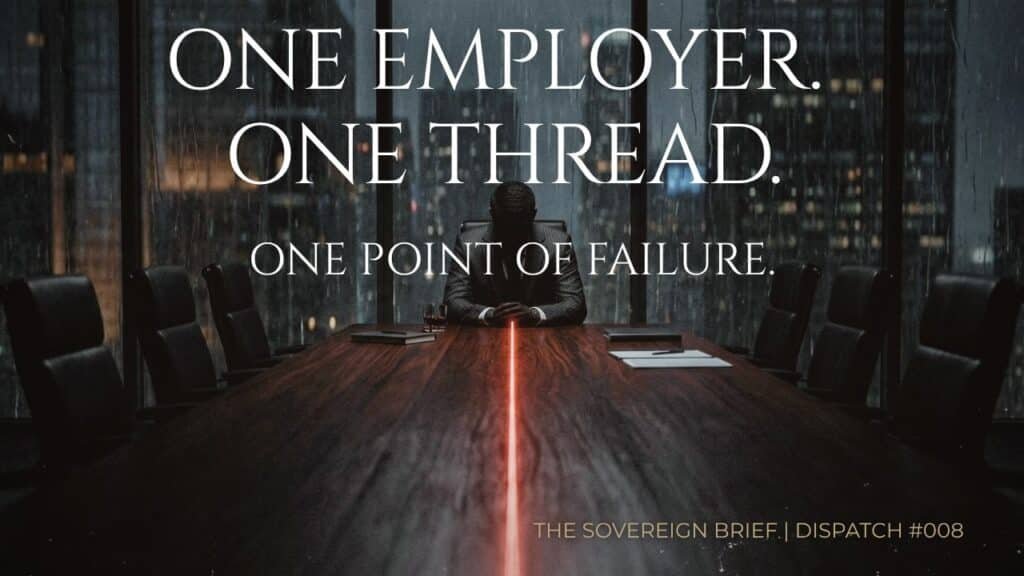
Here is what that number actually represents: one revenue stream. One decision-maker with the authority to eliminate it. One restructuring, one new CFO, one bad quarter — and the entire architecture collapses.
In systems engineering, there is a term for this. Single Point of Failure. It describes any component whose failure brings the entire system down. No redundancy. No backup. No resilience.
You are that component.
The salary isn’t the problem. The structure is.
How the Middle-Management Squeeze Exposed the Flaw
The Middle-Management Squeeze didn’t create the Single Point of Failure problem. It just made it impossible to ignore.
When AI started compressing the $150k–$250k band — eliminating the coordination layer, flattening org charts, automating the Router role — it exposed something uncomfortable. A $200k executive relying on one employer isn’t a Rainmaker. He is a highly paid dependency.
And dependencies get cut.
The executives who survived didn’t work harder. They didn’t accumulate more credentials. They didn’t volunteer for more cross-functional committees.
They changed the structure.
They stopped being employees. They became operators.
What the Fractional C-Suite Actually Is
The Fractional C-Suite model is not a side hustle. This is not about moonlighting or consulting on weekends.
It is a structural reclassification of how executive skills are packaged and sold.
Instead of selling 2,000 hours a year to one employer for a fixed salary, a Fractional C-Suite operator sells focused, high-leverage engagement to multiple clients simultaneously. Typically three. Each client pays a monthly retainer for a defined strategic output — not for presence, not for availability, not for attendance at status meetings.
For output.
This changes everything about the economics.
A fractional COO billing three clients at £8,000–£15,000 per month each generates £24,000–£45,000 monthly — without a single performance review, without a single redundancy risk, without a single boss who can eliminate the entire income stream with one restructuring announcement.
The skills are identical. The packaging is different.
The Three Conditions That Create Fractional Demand
The market for fractional executive talent is not theoretical. It is being driven by three converging forces.
Force One: The Funding Gap. Funded startups and scaling businesses need C-Suite capability without C-Suite overhead. A fractional COO gives a £5M revenue business operational intelligence that would cost £180k+ per year as a full hire — for a fraction of that cost.
Force Two: The Flat Structure Reality. As AI compresses mid-layers, companies are running leaner. They need fewer permanent executives and more specialist operators available on demand.
Force Three: The Proof-of-Work Economy. The credential bubble is deflating. A portfolio of documented results across three clients in 18 months is a more compelling signal than a VP title on a single org chart.
These forces are not temporary. They are structural. And they create permanent, recurring demand for exactly the skills you have spent twenty years building inside a corporation.
The Three Structural Moves
Building fractional income is not complicated. It is uncomfortable. Those are different problems.
Move One: Productise the Expertise. You do not sell hours. You sell an outcome. Define the specific operational or commercial problem you eliminate for clients. Not “operations leadership.” Not “strategic oversight.” The exact, measurable result you deliver. That specificity is the product. The product is what clients buy.
Move Two: Compress the Timeline. Do not wait until you leave the organisation. Begin positioning now. That means building a documented body of work — case studies, frameworks, a public presence that signals expertise to the market you intend to enter. Every dispatch published is positioning capital accumulating while you are still employed.
Move Three: Build the Three-Client Floor. One client is not fractional. It is another single point of failure with a different logo. The structural protection kicks in at three. Three clients means the loss of any single one is a setback, not a collapse. Build to three before you consider any transition.
What This Changes About Your Walk-Away Number
Dispatch #007 established your Walk-Away Number — the exact liquidity required to exit without fear.
The Fractional C-Suite changes the calculation.
A Sovereign Operator with three fractional clients and a Walk-Away Number in place does not need to negotiate from desperation. He does not stay for the Golden Handcuffs because the handcuffs have already been removed.
The number becomes easier to reach. The timeline compresses. And the leverage shifts — from the employer, to the operator.
This is not a career pivot.
It is a structural upgrade.
The Trap — Diagnose Your Current Architecture
Before you build anything, you need to know the exact severity of your current single point of failure.
The Sovereign Audit calculates your Profit Leak Score — a clinical diagnostic that maps your income architecture, your operational drag, and your exposure to the Middle-Management Squeeze.
It takes two minutes.
Run the diagnostic here: sovereign-audit.scoreapp.com
The diagnosis is free. The vulnerability it exposes is not.
The Sovereign Brief is counter-intelligence for corporate life. Published weekly at thesovereign.bond
Darryl Michael Higgins | Founder, The Sovereign Brief
This dispatch is part of the 5-Step Sovereign Protocol.
To secure your career against toxicity and redundancy, you need the full defensive framework.
>> DOWNLOAD THE CLASSIFIED PROTOCOL <<